


Back-to-school season matters not only to students, parents, and teachers. For many local businesses, it can also bring a noticeable change in customer behavior, staffing needs, inventory, marketing, and cash flow.
Retailers may see increased demand for certain products. Restaurants and cafés may experience different traffic patterns. Service businesses may see schedules shift as families return to school routines.
Other businesses may experience the opposite: a temporary slowdown after summer.
That’s why back-to-school financial planning shouldn’t simply mean spending more money on inventory or promotions. It should start with understanding what happened in your business previously, estimating what may happen this year, and making decisions based on current financial information.
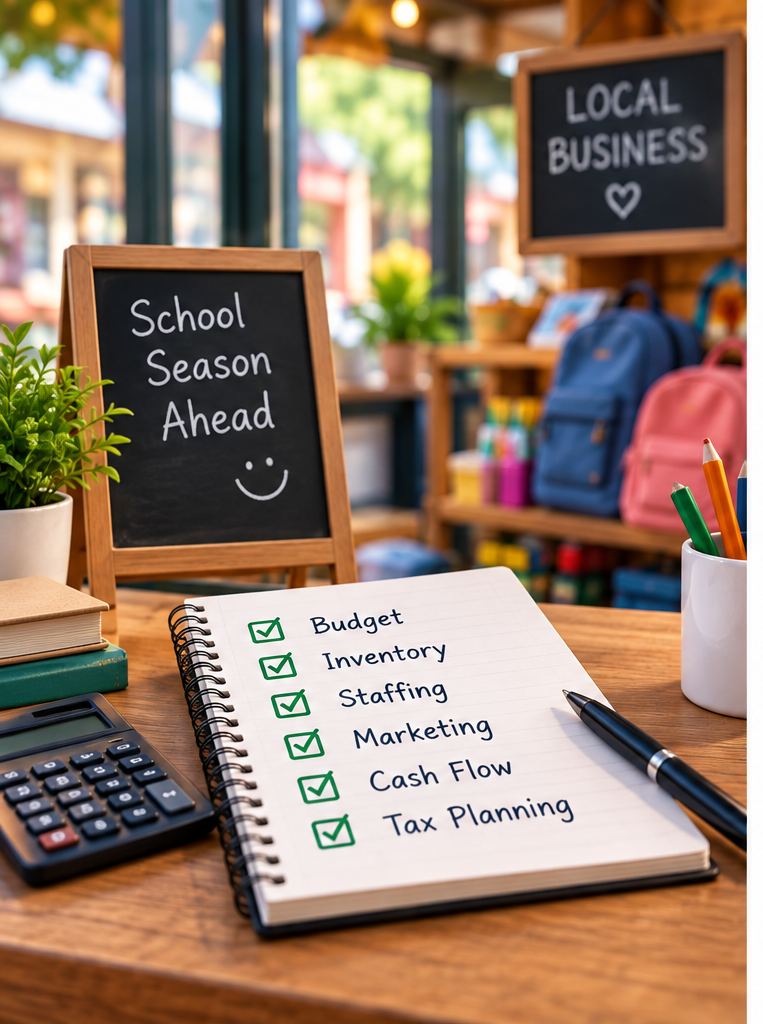
Here are practical ways local businesses can prepare for the 2026 back-to-school season.
Affiliate Disclosure: This article contains affiliate links. If you join Wealthy Affiliate through one of my links, I may earn a commission at no additional cost to you. I recommend only products and services I have personally used or genuinely believe will add value for my readers. All opinions expressed in this review are my own.
1. Start With Last Year’s Numbers
Before creating a seasonal budget, look backward.
Review your bookkeeping records from the same period last year, if available.
Pay particular attention to:
- Revenue
- Cost of goods sold
- Payroll
- Inventory purchases
- Marketing expenses
- Customer payment patterns
- Operating expenses
- Cash balances
Look for patterns rather than focusing solely on sales.
For example, suppose revenue increased substantially during last year’s back-to-school period—but over time, inventory purchases and advertising costs increased even faster.
Sales may have looked impressive while margins told a different story.
That’s why accurate bookkeeping matters.
Good records can help you monitor business performance and prepare financial statements such as income statements and balance sheets. They also provide a more reliable foundation for planning than memory or your bank balance alone.
2. Build a Back-to-School Budget
After reviewing previous results, create a realistic seasonal budget.
Start with expected revenue, but don’t assume this year will automatically match last year.
Consider changes in:
- Customer demand
- Pricing
- Supplier costs
- Wages
- Rent
- Utilities
- Advertising costs
- Competition
- Product mix
- Staffing
Then estimate the additional expenses specific to the season.
For example, a retailer may need additional inventory and temporary staff.
A café near a school may need more ingredients during morning and afternoon rush periods.
A tutoring business may experience increased demand but also need additional instructors.
Your budget should answer a simple question:
If sales increase, what will it cost your business to support those additional sales?
Revenue without expense planning can create an overly optimistic picture.
3. Protect Your Cash Flow
A profitable season can still create cash-flow pressure.
Imagine a retailer expects strong August and September sales.
To prepare, the business purchases additional inventory in July.
Suppliers need to be paid before much of that inventory is sold.
That creates a timing gap between cash going out and cash coming in.
Planning can help you identify that gap before it becomes a problem.
Consider preparing a simple cash-flow forecast showing expected:
Cash inflows
- Cash and card sales
- Customer payments
- Other operating income
Cash outflows
- Inventory
- Payroll
- Rent
- Utilities
- Loan payments
- Marketing
- Vendor payments
- Taxes
- Other operating costs
The goal isn’t to predict every dollar perfectly.
It’s to identify periods when available cash could become tight.
Get a Clearer Picture Before the Busy Season
Back-to-school planning is much easier when your financial records are up to date.
IntegriBooks can help keep your bookkeeping organized, giving you clearer insight into income, expenses, receivables, and financial performance.
Don’t wait until the season is over to find out how your business performed.
Explore IntegriBooks to build a clearer financial picture for your business.
4. Be Careful About Overstocking
More inventory isn’t always better.
Seasonal demand can encourage businesses to buy aggressively because running out of a popular product feels like a missed opportunity.
But excess inventory ties up cash.
And some back-to-school products can quickly lose their seasonal appeal.
Before placing large orders, consider:
- Previous sales volume
- Current inventory
- Supplier lead times
- Minimum order quantities
- Product margins
- Expected demand
- How easily unsold products can be sold later
For businesses that carry inventory, accurate records are especially valuable because purchasing decisions affect both cash flow and profitability.
The objective isn’t to eliminate every stockout.
It’s to balance product availability against the risk of having too much cash sitting on the shelf.
5. Review Staffing Before Adding Hours
A busier season may require more labor, but don’t base staffing decisions solely on revenue expectations.
Look at when customer demand actually occurs.
You might find that you need additional help only on certain days or during certain hours, rather than throughout the entire week.
Compare anticipated labor costs with expected demand and consider the full cost of adding employees—not just their hourly wage.
Depending on the situation, employer responsibilities may include federal income tax withholding, Social Security and Medicare taxes, federal unemployment tax, and applicable state or local requirements.
Don’t classify workers as independent contractors just because it seems easier or cheaper. Worker classification depends on the facts and applicable rules.
6. Plan Promotions Around Profit, Not Just Sales
Back-to-school discounts can attract customers.
They can also shrink margins.
Before launching a promotion, calculate its impact on profitability.
Suppose an item normally sells for $50 and costs your business $30.
Your gross profit before other expenses is $20.
A 20% discount reduces the selling price to $40, leaving only $10 before other operating expenses.
You would need substantially more unit sales to generate the same total gross profit.
That doesn’t mean discounts are bad.
It means they should have a purpose.
A promotion might make sense to:
- Attract new customers
- Increase average transaction value
- Move seasonal inventory
- Encourage repeat visits
- Introduce a new service
Measure success using more than revenue.
Margins matter too.
7. Don’t Assume Every Back-to-School Purchase Is Tax-Deductible
This is an area where small business articles can easily become misleading.
Buying something during the back-to-school season doesn’t make it a business deduction.
For federal income-tax purposes, a deductible business expense generally must be ordinary and necessary for carrying on the business.
An ordinary expense is common and accepted in your trade or business. A necessary expense is helpful and appropriate for the business.
Personal expenses generally aren’t deductible as business expenses.
So if a business owner buys:
- Office supplies used by the business
- Eligible advertising
- Business software
- Certain employee-related supplies
- Other legitimate operating expenses
Those costs may qualify for appropriate tax treatment depending on the facts and applicable rules.
But school supplies purchased for the owner’s children aren’t deductible just because they were bought with a business credit card.
Mixed personal and business expenses may also need to be separated.
Keep documentation showing what was purchased and why it relates to the business.
8. Keep Seasonal Receipts and Records Organized
Busy periods are when bookkeeping can easily fall behind.
Receipts accumulate.
Transactions remain uncategorized.
Invoices get overlooked.
Then, months later, someone has to reconstruct what happened.
Avoid that cycle by establishing a routine before business picks up.
Your records may include:
- Sales records
- Supplier invoices
- Receipts
- Bank transactions
- Credit-card activity
- Payroll information
- Customer invoices
- Inventory purchases
- Deposit records
The IRS generally doesn’t require businesses to use a particular bookkeeping system. The system should suit the business and clearly show income and expenses.
Digital records are acceptable, provided applicable recordkeeping requirements are satisfied.
9. Review Accounts Receivable
Businesses that invoice customers should pay particular attention to accounts receivable.
Strong sales don’t immediately improve cash flow when customers haven’t paid.
Review:
- Outstanding invoices
- Overdue balances
- Customer payment patterns
- Unapplied payments
- Invoices that haven’t been sent
If a customer normally takes 45 days to pay, don’t build a cash-flow forecast assuming the money will arrive next week.
Use realistic collection patterns.
This becomes especially important when the business must pay employees and vendors before customer payments arrive.
10. Don’t Guess at Estimated Taxes
A busy season can increase taxable income, which may affect estimated tax requirements.
But avoid generic advice such as:
“Always put 25% of your revenue aside for taxes.”
There isn’t one percentage that works for every business.
Federal estimated-tax requirements depend on factors including income, deductions, credits, withholding, business structure, and prior-year tax information.
For individuals—including many sole proprietors, partners, and S corporation shareholders—estimated payments generally become necessary when they expect to owe at least $1,000 after withholding and refundable credits, and when they meet additional IRS tests.
Corporations follow different rules.
If your income changes substantially during the back-to-school season, consider reviewing your tax projections with a qualified tax professional rather than relying on a generic percentage.
11. Separate Business and Personal Spending
Back-to-school season creates plenty of personal expenses for business owners with families.
That makes separation particularly important.
Avoid mixing personal school shopping with business purchases whenever possible.
Using dedicated business accounts can simplify bookkeeping and create a clearer record of business transactions.
If a transaction includes both personal and business components, make sure the business portion is properly identified and documented.
Clean separation saves time later and reduces the risk of treating personal spending as a business expense.
12. Compare Actual Results With Your Budget
Financial planning shouldn’t stop once the season begins.
Compare actual performance against your expectations.
Ask:
- Are sales meeting projections?
- Are margins holding up?
- Is payroll running higher than planned?
- Is inventory moving?
- Are customers paying on time?
- Are marketing campaigns generating worthwhile results?
- Are expenses increasing unexpectedly?
- Is cash flow stronger or weaker than expected?
If demand is lower than expected, you may need to reduce future inventory orders.
If a promotion is working well, you might decide to extend it.
If one product is selling significantly faster than anticipated, you may need to reorder sooner.
A budget becomes much more valuable when it’s used as a management tool rather than created once and forgotten.
A Simple Back-to-School Financial Checklist
Before the season:
- Review last year’s financial results
- Update bookkeeping
- Build a seasonal budget
- Forecast cash inflows and outflows
- Review inventory
- Evaluate staffing needs
- Plan promotions based on margins
During the season:
- Keep transactions current
- Monitor sales and expenses
- Watch inventory levels
- Review receivables
- Compare actual results with your budget
- Monitor available cash
After the season:
- Reconcile accounts
- Review profitability
- Evaluate promotions
- Review remaining inventory
- Compare results with projections
- Document lessons for next year

Turn Seasonal Activity Into Better Financial Information
Back-to-school season can create opportunities for local businesses, but increased activity doesn’t automatically translate into stronger financial performance.
Better-prepared businesses can see more than just sales.
They can see expenses, margins, receivables, inventory, upcoming obligations, and cash flow.
That visibility makes it easier to adjust when actual results don’t match the plan.
And when the season ends, good records provide something equally valuable:
information you can use to plan next year’s season more intelligently.
Make Your Books Part of Your Business Plan
Your bookkeeping shouldn’t simply tell you what happened months ago.
Current, organized financial records can help you understand what’s happening in your business now and provide better information for planning what comes next.
IntegriBooks helps small businesses keep their books organized and their financial information clear and easy to understand.
Whether you’re preparing for a busy season or simply trying to get a better handle on your numbers, connect with IntegriBooks and build a stronger bookkeeping routine for your business.
Disclaimer: This article provides general educational information and is not individualized accounting, tax, legal, or financial advice. Tax treatment and financial decisions depend on each business’s facts and circumstances. Consult a qualified professional about your specific situation.