

An S corporation can offer valuable tax advantages for some small business owners—but the rules are often misunderstood.
You may have heard that an S corp lets you “avoid self-employment tax” or pay yourself mostly through distributions. That’s an oversimplification. S corporation taxation involves several separate concepts, including pass-through income, shareholder-employee wages, payroll taxes, distributions, stock basis, and reasonable compensation.
Affiliate Disclosure: This article contains affiliate links. If you join Wealthy Affiliate through one of my links, I may earn a commission at no additional cost to you. I recommend only products and services I have personally used or genuinely believe will add value for my readers. All opinions expressed in this review are my own.
Here’s how the basics work.
What Is an S Corporation?
An S corporation is a federal tax classification, not necessarily a separate type of business entity.
For example, an eligible corporation can elect S corporation status. An eligible LLC may also elect to be taxed as an S corporation while remaining an LLC under state law.
For federal purposes, an S corporation generally passes income, losses, deductions, and credits through to its shareholders rather than paying federal income tax on that operating income at the corporate level.
However, certain entity-level federal taxes can still apply in specific circumstances.
Who Can Elect S Corporation Status?
To qualify, a business generally must:
- Be a domestic corporation or eligible domestic entity.
- Have no more than 100 shareholders
- Have only eligible shareholders
- Have no nonresident-alien shareholders, subject to limited special rules
- Have only one class of stock, although differences in voting rights may be permitted
- Not be an ineligible corporation.
The business generally makes the election by filing Form 2553, Election by a Small Business Corporation, with the required shareholder consents.
Form 2553 generally must be filed no later than 2 months and 15 days after the beginning of the tax year the election is intended to take effect. Relief may be available for certain late elections.
How Are S Corporations Taxed?
An S corporation generally files Form 1120-S, an informational federal income tax return reporting the company’s income, deductions, gains, losses, credits, and other tax items.
The corporation also provides each shareholder with Schedule K-1, reporting that shareholder’s allocated share of applicable tax items.
Those items generally flow through to the shareholder’s individual tax return.
One important point: you can owe income tax on your share of S corporation income even if the business doesn’t distribute that amount to you in cash.
That’s why business profit and cash distributions shouldn’t be treated as interchangeable terms.
S corporation tax planning starts with accurate financial records. See how IntegriBooks can help keep your business books organized and tax-ready.
S Corp Salary vs. Distributions: What’s the Difference?

This is one of the most misunderstood parts of S corporation taxation.
W-2 wages
When a shareholder performs more than minor services for the corporation and receives or is entitled to compensation, the shareholder may be an employee.
Wages paid to a shareholder-employee are generally subject to applicable income-tax withholding and employment taxes, including Social Security and Medicare taxes.
The corporation also takes on normal payroll responsibilities, including payroll deposits and employment-tax filings.
Pass-through income
A shareholder’s allocated share of S corporation income is generally reported through Schedule K-1.
That pass-through business income generally isn’t self-employment income and isn’t subject to self-employment tax.
That doesn’t mean it escapes income tax.
Distributions
A distribution is cash or property transferred from the corporation to a shareholder.
For an S corporation without complicating C-corporation history, a non-dividend distribution is generally tax-free to the extent it doesn’t exceed the shareholder’s stock basis. Amounts exceeding stock basis can result in taxable gain.
So “distribution” and “taxable S corporation profit” aren’t the same thing.
What Is Reasonable Compensation?
An S corporation cannot simply characterize compensation for a working shareholder as distributions to avoid employment taxes.
The IRS requires an S corporation to pay reasonable compensation to a shareholder-employee for services provided before making non-wage distributions to that shareholder-employee.
There is no universal IRS-approved salary percentage or salary-to-distribution ratio.
Relevant factors can include:
- Training and experience
- Duties and responsibilities
- Time devoted to the business
- What comparable businesses pay
- Payments to other employees
- Compensation agreements
- How the business generates its revenue
If a shareholder’s services generate much of the company’s revenue, paying a very small salary while taking substantial non-wage distributions can create tax risk.
The IRS can reclassify purported distributions or other payments as wages when appropriate.
Why Does Shareholder Stock Basis Matter?
Stock basis is essentially a tax-accounting measure of a shareholder’s investment in the S corporation, adjusted over time.
Basis generally changes as the company earns income, incurs losses, and makes distributions.
It matters because it can affect:
- Whether a distribution is taxable
- Whether a shareholder can deduct pass-through losses
- The tax consequences of selling stock
Shareholders are responsible for tracking their own stock and debt basis.
Schedule K-1 provides information used in the calculation, but the K-1 itself doesn’t tell you how much of a non-dividend distribution is taxable.
Form 7203 may be required or useful for calculating and reporting stock and debt basis limitations.
Can S Corporation Losses Reduce Your Taxes?
Potentially, but receiving a loss on Schedule K-1 doesn’t automatically mean the entire loss is currently deductible.
A shareholder first needs sufficient stock and/or qualifying debt basis. Other restrictions may also apply, including at-risk, passive-activity, and excess-business-loss limitations.
Unused losses may potentially be suspended until applicable requirements are satisfied.
Do S Corporation Owners Pay Estimated Taxes?
They may.
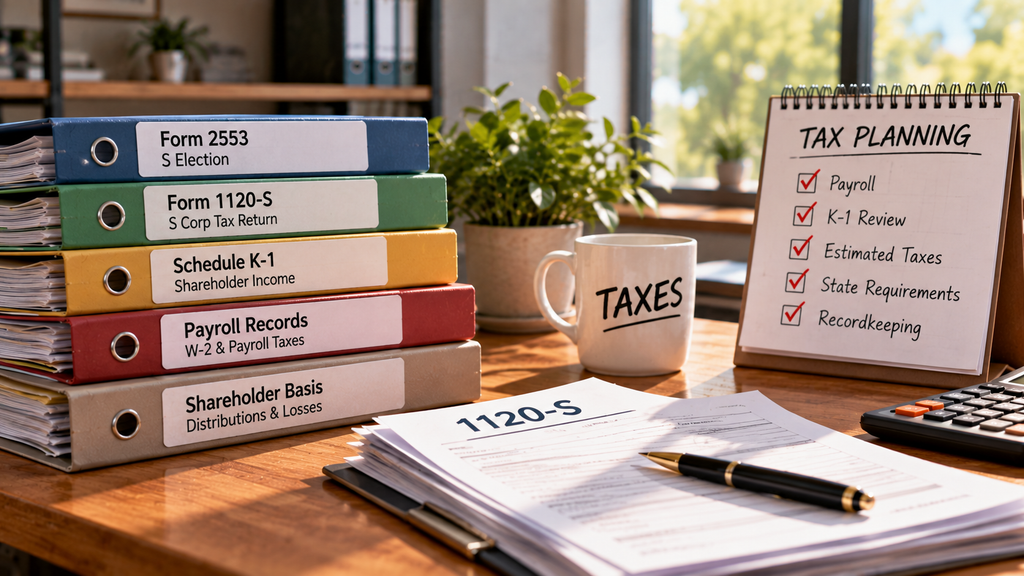
Because pass-through S corporation income generally doesn’t have federal income tax automatically withheld, shareholders may need estimated tax payments to cover their individual tax liability.
For 2026, an individual generally needs estimated payments when both of these conditions apply:
- The person expects to owe at least $1,000 after withholding and refundable credits; and
- Expected withholding and credits are less than the smaller of 90% of the current year’s tax or 100% of the prior year’s tax, assuming the prior return covered 12 months.
For certain higher-income taxpayers, the prior-year percentage generally increases to 110%.
A shareholder receiving W-2 wages can also consider adjusting federal income-tax withholding from payroll.
The S corporation itself may have separate estimated-tax obligations for certain entity-level taxes.
Does the Qualified Business Income Deduction Apply?
Some S corporation shareholders may qualify for the qualified business income (QBI) deduction.
For tax years beginning after 2025, federal law continues the Section 199A deduction, with eligible taxpayers potentially receiving a deduction based on qualified business income.
However, limitations can depend on factors such as taxable income, business type, W-2 wages, and qualified property.
Importantly, reasonable compensation paid to an S corporation shareholder isn’t QBI.
Eligibility should therefore be evaluated separately from the decision to elect S corporation status.
Federal vs. State S Corporation Taxes
An S election doesn’t guarantee identical treatment in every state.
Depending on where the business operates, a state may impose:
- Entity-level income or franchise taxes
- Minimum taxes or fees
- Separate S-election requirements
- Shareholder withholding requirements
- Annual reports or other compliance obligations
A business operating in multiple states may have additional filing requirements.
Always evaluate the federal election and state tax treatment separately.
Is an S Corporation Always Better for Taxes?
No.
An S election may become attractive when a profitable business can pay its working owner reasonable compensation while still generating income beyond those wages.
But potential payroll-tax savings should be weighed against additional costs such as:
- Payroll administration
- Form 1120-S preparation
- Bookkeeping and accounting
- Basis tracking
- State taxes and fees
- Additional compliance requirements
A business with little profit beyond reasonable owner compensation may find that the additional complexity reduces or eliminates the expected benefit.
Common S Corporation Tax Mistakes
Common problems include paying shareholder-employees unreasonably low wages, confusing distributions with pass-through income, failing to run payroll properly, overlooking stock basis, taking distributions without understanding their tax consequences, missing payroll deposits or tax filings, and assuming federal S status automatically determines state treatment.
Another mistake is electing S corporation status simply because someone says it will “save taxes.”
The decision should be based on the business’s actual profit, reasonable owner compensation, state rules, administrative costs, and broader tax situation.
S Corporation Tax FAQs
Does an S corp pay federal income tax?
Generally, operating income passes through to shareholders, but certain entity-level federal taxes can apply in specific circumstances.
Are S corp distributions tax-free?
Not automatically. A typical non-dividend distribution is generally tax-free only to the extent of the shareholder’s stock basis. Different rules can apply in other circumstances.
Does an S corp owner have to take a salary?
A shareholder who performs more than minor services and receives or is entitled to compensation generally must be treated appropriately as an employee. Reasonable compensation rules apply before non-wage distributions to shareholder-employees.
Is S corporation income subject to self-employment tax?
A shareholder’s pass-through share of S corporation income generally isn’t self-employment income. W-2 wages paid to a shareholder-employee are instead subject to applicable employment taxes.
Can an LLC become an S corporation?
An eligible LLC can elect S corporation taxation while remaining an LLC under state law.
Keep Your S Corporation Books Tax-Ready
S corporation taxation works best when payroll, shareholder distributions, business expenses, and equity transactions are recorded accurately throughout the year.
Clean books also make it easier to prepare Form 1120-S, issue Schedule K-1s, support reasonable-compensation decisions, and maintain the information shareholders need for basis calculations.
Do you need better financial records for your S corporation? Visit IntegriBooks to learn how professional bookkeeping support can keep your business finances organized year-round.