


Forming a limited liability company can provide flexibility in how a business is structured, but creating an LLC doesn’t automatically determine how the business will be taxed.
That’s because an LLC is a legal structure created under state law—not a federal tax classification.
For federal income-tax purposes, the IRS may treat an LLC as a disregarded entity, partnership, C corporation, or S corporation depending on the number of owners and any tax elections the business makes.
Understanding those differences can help you anticipate tax filings, payroll responsibilities, estimated payments, and bookkeeping requirements.
Affiliate Disclosure: This article contains affiliate links. If you join Wealthy Affiliate through one of my links, I may earn a commission at no additional cost to you. I recommend only products and services I have personally used or genuinely believe will add value for my readers. All opinions expressed in this review are my own.
Is an LLC a Tax Classification?
No.
LLC stands for limited liability company. States establish LLCs under their own laws, while federal tax rules determine how the business is treated for federal tax purposes.
For a domestic LLC, the default federal income-tax treatment generally works like this:
| LLC structure | General federal income-tax treatment |
|---|---|
| One member | Disregarded entity by default |
| Two or more members | Partnership by default |
| LLC electing C-corp treatment | Corporation |
| Eligible LLC electing S-corp treatment | S corporation |
Exceptions and special situations exist, so these are general rules rather than a classification for every LLC.
How Is a Single-Member LLC Taxed?
A domestic LLC with one owner is generally a disregarded entity for federal income-tax purposes unless it elects corporate treatment.
For an individual owner operating an active trade or business, income and expenses are commonly reported on Schedule C with Form 1040. Depending on the activity, another schedule may apply instead.
Being disregarded doesn’t mean the business is ignored for every federal tax purpose. A single-member LLC can still be treated separately for employment taxes and certain excise taxes.
What About Self-Employment Tax?
An individual owner operating a trade or business through a disregarded single-member LLC is generally subject to self-employment tax in the same manner as a sole proprietor.
The standard self-employment tax rate is 15.3%, which includes Social Security and Medicare. But it is inaccurate to say that 15.3% applies to every dollar of LLC profit.
Generally, 92.35% of net earnings from self-employment is used in the calculation, and the Social Security portion is subject to an annually adjusted wage base.
Because certain tax figures change over time, business owners should use current-year guidance rather than relying on an old tax limit.
How Is a Multi-Member LLC Taxed?
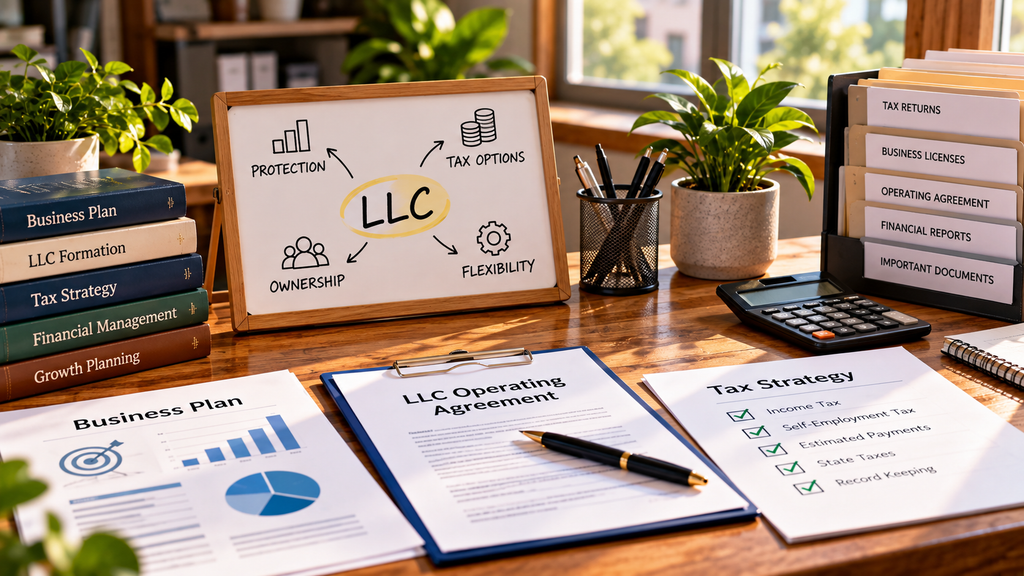
A domestic LLC with two or more members is generally treated as a partnership for federal income-tax purposes unless it elects to be taxed as a corporation.
The LLC generally files Form 1065, an informational partnership return. Members receive Schedule K-1, showing their respective shares of partnership income, deductions, credits, and other tax items.
Profits may therefore be taxable to members even when all of that cash hasn’t actually been distributed.
Self-employment tax becomes more complicated here. Members performing services for an LLC taxed as a partnership are generally treated as self-employed rather than employees, but whether a member’s distributive share is included in net earnings from self-employment can depend on the circumstances and applicable tax rules.
That is one reason multi-member LLCs should avoid assuming every member’s tax situation is identical.
Good LLC tax planning starts with reliable financial records. See how IntegriBooks can help keep your business bookkeeping organized and tax-ready.
Can an LLC Be Taxed as a C Corporation?
Yes.
An eligible LLC can generally elect corporate tax classification using Form 8832.
Once treated as a C corporation, the business generally files Form 1120, and the corporation itself is subject to federal corporate income tax.
If after-tax corporate earnings are later distributed to owners as taxable dividends, tax can potentially occur at both the corporate and shareholder levels.
That doesn’t automatically make C-corp treatment a poor choice. The appropriate structure depends on factors such as compensation, benefits, reinvestment plans, ownership, financing strategy, and long-term business objectives.
Don’t choose it simply because one tax rate appears lower than another.
How Is an LLC Taxed as an S Corporation?
An eligible LLC can elect S-corporation tax treatment, generally by filing Form 2553.
A timely Form 2553 from an eligible entity can also serve as the necessary election to be classified as a corporation, meaning a separate Form 8832 isn’t necessarily required first.
An S corporation generally files Form 1120-S, while income, deductions, credits, and other tax items generally pass through to shareholders and are reported on Schedule K-1.
Does an S Corporation Eliminate Self-Employment Tax?
This is where LLC tax explanations can become misleading.
An S corporation shareholder who performs more than minor services for the company and receives or is entitled to compensation generally must be treated as an employee and receive reasonable compensation.
Those wages are subject to applicable employment/payroll taxes. They aren’t simply treated as self-employment income.
S-corporation distributions aren’t automatically treated as wages, but owners cannot simply replace reasonable wages with distributions to avoid employment taxes. Payments can potentially be reclassified when appropriate.
Therefore, an S-corp election shouldn’t be viewed as an automatic tax-saving strategy.
Potential savings need to be weighed against reasonable-compensation requirements, payroll administration, tax preparation, bookkeeping, state rules, and other compliance costs.
Do LLC Owners Pay Estimated Taxes?
They may.
Owners of pass-through businesses frequently don’t have federal income tax withheld from their business income, so estimated payments may be necessary.
But having an LLC doesn’t automatically mean quarterly payments are required. Estimated-tax requirements depend on factors such as expected tax liability, withholding, credits, other income, and the owner’s overall tax situation.
S-corporation shareholder-employees may also have taxes withheld from wages through payroll while still needing estimated payments for other income.
Federal LLC Taxes vs. State LLC Taxes
Federal tax classification is only one part; states form LLCs under their own laws and can impose additional requirements.
Depending on the state and business, these can include:
- Income taxes
- Franchise or privilege taxes
- Annual LLC fees
- Sales and use taxes
- Payroll taxes
- Annual reports
- Business registrations or licenses
Local governments may impose additional requirements.
Don’t assume that electing S corporation treatment for federal tax purposes automatically creates identical treatment at the state level. Review state requirements separately.
When Should an LLC Consider Changing Its Tax Treatment?

No universal profit level determines when an LLC should become an S corporation or a C corporation.
Instead, consider factors such as:
Business profit: Is the company consistently profitable?
Reasonable compensation: If considering an S corporation, what would reasonable compensation be for the owner’s services?
Payroll and administrative costs: Would additional compliance expenses offset potential tax advantages?
State taxes: How does your state treat the election?
Ownership and growth plans: Will ownership change or outside investment become important?
Benefits and reinvestment: Would corporate treatment better fit the company’s longer-term plans?
Tax elections can also have deadlines and restrictions. Run the numbers before changing classifications rather than making an election based on a generic income threshold.
LLC Tax FAQs
Does an LLC pay federal income tax itself?
It depends.
A disregarded single-member LLC generally reports business activity through its owner. An LLC taxed as a partnership generally files Form 1065, while tax items pass through to members. A C corporation generally pays corporate income tax itself, while an S corporation generally passes tax items through to shareholders.
Do LLC owners pay tax on money left in the business?
Potentially.
With pass-through taxation, taxable income isn’t determined solely by how much cash an owner withdraws. Owners can potentially owe tax on allocated business income even when some cash remains in the company.
Can an LLC change its federal tax classification?
Generally, yes, if it meets the eligibility requirements.
Elections have timing requirements, and changing classification can have tax consequences, so professional guidance may be appropriate.
Do LLC members go on payroll?
It depends on the tax classification.
Partners in an LLC taxed as a partnership are generally considered self-employed rather than employees when performing services for the partnership. Shareholder-employees of an LLC taxed as an S corporation are subject to different compensation and payroll requirements.
Choosing the Right LLC Tax Treatment
The biggest takeaway is simple: forming an LLC and choosing how that LLC is taxed are two different decisions.
A single-member LLC may start with disregarded-entity treatment. A multi-member LLC may default to partnership treatment. Eligible businesses can consider C-corporation or S-corporation taxation when those structures better support their financial and operational needs.
The right choice depends on the actual numbers—not on the assumption that one tax classification is always cheaper.
Accurate bookkeeping makes that comparison much easier because you’ll have reliable information about revenue, expenses, profit, owner payments, and cash flow.
Is your current business structure still meeting your financial needs? Visit IntegriBooks to learn how organized bookkeeping can give you a clearer foundation for tax planning and business decisions.