


Running a business from home can save money on rent and commuting. But did you know some household expenses might also qualify for a tax deduction?
The home office deduction can help eligible small business owners reduce their taxable business income. However, simply working from home doesn’t automatically qualify you.
Here’s how the deduction works, who qualifies, and how to choose the calculation method that makes sense for your business.
Affiliate Disclosure: This article contains affiliate links. If you join Wealthy Affiliate through one of my links, I may earn a commission at no additional cost to you. I recommend only products and services I have personally used or genuinely believe will add value for my readers. All opinions expressed in this review are my own.
What Is the Home Office Deduction?
The home office deduction allows eligible taxpayers to deduct certain expenses associated with using part of their home for business.
You don’t have to own your home to qualify. Renters may also be eligible.
Depending on the calculation method, deductible costs can include a business portion of rent, mortgage interest, utilities, insurance, repairs, and depreciation.
A deduction reduces income subject to tax—not your tax bill dollar-for-dollar. The actual savings depend on your tax situation.
Who Qualifies for the Home Office Deduction?
Self-employed individuals, sole proprietors, and certain partners may qualify when they use part of their home for an eligible business purpose.
Generally, the space must be used regularly and exclusively for business and satisfy at least one qualifying use test.
Common qualifying situations include:
- Using the space as your principal place of business
- Regularly meeting clients, customers, or patients in the course of normal business.
- Regularly and exclusively using a separate, unattached structure for business.
Special rules also apply to qualifying inventory storage, daycare facilities, and certain rental activities.
A dedicated corner of a room can qualify. You don’t necessarily need an entire room or a separate entrance.
What Does Regular and Exclusive Use Mean?
Regular use means using the space for business consistently rather than occasionally.
Exclusive use means the designated area isn’t also used for personal activities.
For example, a freelancer who uses a dedicated bedroom corner solely for client work may qualify. Someone who works at the family dining table, where meals are also served, generally won’t satisfy the exclusive-use test.
Important Exceptions
The IRS provides exceptions to exclusive use for certain activities.
Inventory or product storage: A qualifying business selling products at retail or wholesale may use part of the home regularly for inventory or product samples if the home is the business’s only fixed location and other requirements are met.
Daycare facilities: Qualifying daycare providers may deduct eligible business use of shared spaces, with special rules accounting for the time those spaces are used for daycare.
These exceptions aren’t blanket permission to deduct any multipurpose room.
What Counts as Your Principal Place of Business?
Your home doesn’t have to be where you perform every business task.
Suppose a self-employed electrician spends most working hours at customers’ properties but handles scheduling, invoicing, and bookkeeping from a dedicated home office.
That home office may qualify as the principal place of business if it’s used regularly and exclusively for substantial administrative or management activities and the electrician has no other fixed location where substantial administrative or management work is performed.
Other qualifying-use tests may apply even when the home isn’t the principal place of business.
Simplified vs. Actual-Expense Method
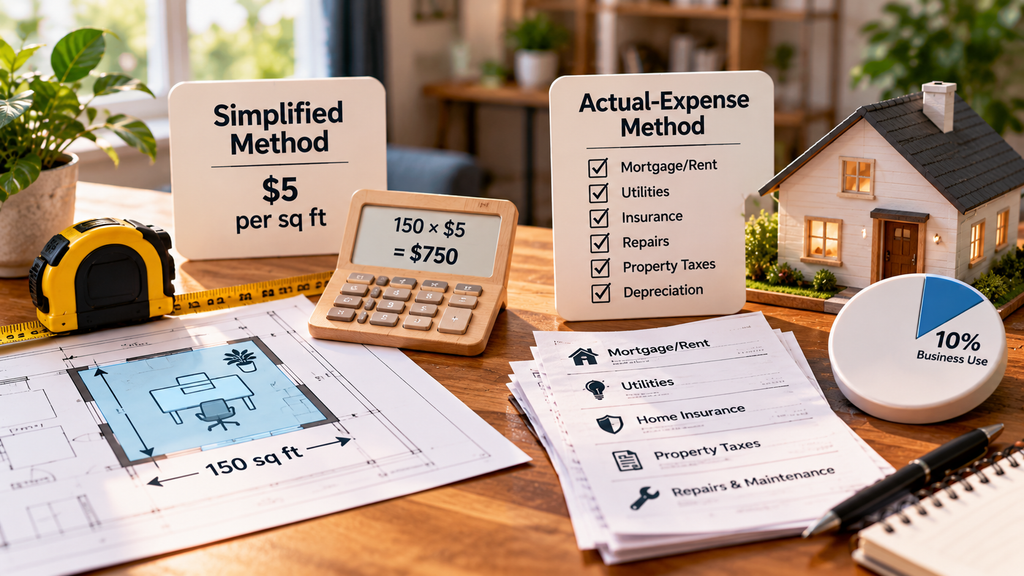
The IRS offers two main ways to calculate the home office deduction.
| Feature | Simplified method | Actual-expense method |
|---|---|---|
| Calculation | $5 per qualifying square foot | Eligible actual home expenses |
| Space limit | 300 square feet | Actual qualifying business-use percentage |
| Maximum basic calculation | $1,500 annually | No fixed dollar cap; limitations apply |
| Home depreciation | Not deducted | May apply |
| Recordkeeping | Less expense tracking | Detailed expense records needed |
| Unused deduction | No carryover | Certain limited amounts may carry forward |
1. Simplified Method
Multiply the qualifying square footage by $5, subject to the 300-square-foot limit.
For example:
150 square feet × $5 = $750
That’s the potential deduction before applying any applicable limitations.
The simplified method reduces the need to allocate actual household expenses. However, you must still establish eligibility and document the space used.
Special calculations apply when the business use lasts only part of the year or involves qualifying daycare use.
2. Actual-Expense Method
The actual-expense method generally uses the percentage of your home devoted to qualifying business use.
Suppose your home is 2,000 square feet and your qualifying office occupies 200 square feet.
Your business-use percentage would be:
200 ÷ 2,000 = 10%
You could generally allocate 10% of eligible indirect home expenses to business use, subject to the applicable rules and limits.
Some expenses receive different treatment, so you shouldn’t simply multiply every household bill by 10%.
Which Home Office Expenses Can You Deduct?

Under the actual-expense method, expenses generally fall into three categories.
Direct expenses: Costs benefiting only the business area, such as painting the dedicated office. These are generally fully allocable to business use, subject to applicable rules.
Indirect expenses: Costs benefiting the entire home, such as utilities, homeowners insurance, rent, and certain repairs. These are generally allocated using the business-use percentage.
Unrelated expenses: Costs benefiting only personal areas, such as remodeling a family bedroom, generally aren’t home office deductions.
Mortgage interest and property taxes have additional allocation rules. Home improvements may need to be capitalized and depreciated rather than deducted immediately.
Internet service and equipment should also be evaluated separately according to their actual business use and applicable deduction rules.
Good records make these calculations easier. See how IntegriBooks can help keep your small-business books organized and tax-ready.
Can the Home Office Deduction Affect Selling Your House?
Yes, especially if you use the actual-expense method.
Homeowners who claim depreciation for business use generally must account for depreciation allowed or allowable when calculating gain on a later sale.
This can create taxable gain even when other parts of the home-sale gain qualify for an exclusion.
With the simplified method, home office depreciation is treated as zero for the years you use it.
This difference is worth considering when comparing the two methods.
Are There Limits on the Deduction?
Yes. The home office deduction generally cannot exceed the applicable gross income from business use of the home after certain other business expenses.
With the simplified method, an amount disallowed by that limitation cannot be carried forward.
With the actual-expense method, certain disallowed expenses may be carried forward, subject to future limitations.
You generally choose the method on a timely filed original return and cannot switch methods for that same tax year afterward.
Can Employees Claim the Home Office Deduction?
For federal income-tax purposes, employees generally cannot deduct unreimbursed home office expenses, even when their employer requires remote work.
The federal suspension of most miscellaneous itemized deductions for unreimbursed employee expenses became permanent beginning with tax years after 2025. Narrow statutory exceptions for certain employee expenses remain, but they don’t create a general home office deduction for remote employees.
Some states may have different rules. Employees can also ask whether their employer offers reimbursement under an appropriate accountable plan.
How Do You Claim the Home Office Deduction?
A qualifying sole proprietor generally uses:
- Form 8829 with Schedule C for the actual-expense method.
- The simplified-method calculation on Schedule C when choosing that option
Partners, farmers, and other taxpayers may follow different reporting procedures.
The deduction is calculated as part of the applicable business tax return, not claimed simply because you worked remotely.
What Records Should You Keep?
Keep documentation that supports your eligibility, business-use percentage, and deductible expenses.
Useful records include a floor plan or measurements, photographs showing the designated workspace, records of business activities, utility and insurance statements, rent or mortgage records, repair invoices, and depreciation records when applicable.
No universal three-year retention period applies to every document. Property-related records may need to be kept much longer to establish basis and depreciation when you eventually sell the home.
Federal vs. State Home Office Deductions
Federal qualification doesn’t automatically determine your state deduction.
State income-tax rules may differ in how they treat employee expenses, business deductions, depreciation, or other tax adjustments.
Check the rules in each state where you must file.
Home Office Deduction FAQs
Can I deduct my dining room table?
Generally not if the same area is also used for family meals or other personal activities. Exclusive-use exceptions are limited.
Can I claim the deduction if I rent?
Yes, eligible renters may qualify under the same business-use requirements.
What if I only work from home part of the year?
You may qualify for a partial-year deduction. The simplified method uses special monthly square-footage rules; the actual-expense method generally considers eligible expenses during the qualifying period.
Which method saves more money?
It depends on your qualifying space, eligible household expenses, income limitations, and depreciation considerations. Neither method is automatically better.
Does claiming a home office automatically trigger an audit?
There is no sound basis for claiming that an otherwise legitimate home office deduction automatically triggers an audit. Accurate reporting and supporting records remain important.
Make Your Home Office Deduction Count
A dedicated workspace can provide a legitimate tax benefit, but qualifying is only the first step.
Understanding the rules, comparing calculation methods, and maintaining accurate records can help you claim the deduction you’re entitled to without overstating expenses.
Want your bookkeeping in better shape before tax season? Visit IntegriBooks to learn how organized financial records can help your business stay prepared year-round.