

Bookkeeping advice is everywhere. Unfortunately, not all of it is accurate.
Small business owners often hear that bookkeeping only matters at tax time, that accounting software can handle everything automatically, or thata healthy bank balance means the business is profitable.
Those assumptions can create confusion—and sometimes poor financial decisions.
Good bookkeeping doesn’t have to be complicated. But it should give you reliable information about your income, expenses, cash, liabilities, and overall financial position.
Let’s separate some of the most common bookkeeping myths from the facts.
Affiliate Disclosure: This article contains affiliate links. If you join Wealthy Affiliate through one of my links, I may earn a commission at no additional cost to you. I recommend only products and services I have personally used or genuinely believe will add value for my readers. All opinions expressed in this review are my own.

Myth #1: My Business Is Too Small to Worry About Bookkeeping
The truth: Bookkeeping matters from the moment your business begins generating financial activity.
You don’t need an elaborate accounting department to run a small business, but you do need an organized way to record what comes in and what goes out.
Good records can help you:
- Track income and expenses
- Monitor business performance
- Prepare financial statements
- Support tax-return information
- Understand what customers owe you
- Track what you owe vendors and lenders
Your bookkeeping system can start simple and become more sophisticated as your business grows.
What matters is that your records clearly and accurately reflect what’s happening financially.
Myth #2: Bookkeeping Only Matters at Tax Time
The truth: Your books should help you manage your business throughout the year.
Taxes are only one reason to maintain good financial records.
Waiting until tax season to organize an entire year’s worth of transactions makes it easier to forget expenses, lose documentation, misclassify transactions, or overlook problems.
Regular bookkeeping also gives you information you can use now.
For example, your financial records may reveal that operating expenses are increasing faster than sales, customers are taking longer to pay, or certain products aren’t generating the margins you expected.
Those are business-management issues—not just tax issues.
IntegriBooks Tip
Don’t treat bookkeeping as an annual cleanup project. A consistent weekly or monthly routine can make your financial information much more useful.
Myth #3: My Bank Balance Tells Me Whether My Business Is Profitable
The truth: Cash in the bank and profit are not the same thing.
A healthy bank balance is certainly useful, but it doesn’t provide the complete financial picture.
Suppose your account contains $40,000.
That sounds great—until you realize the business also has $15,000 in unpaid vendor bills, upcoming payroll, loan payments, tax obligations, and other liabilities.
The opposite can happen too.
A profitable company can experience cash-flow pressure when customers haven’t paid outstanding invoices or when the business invests heavily in inventory or equipment.
That’s why business owners should look beyond the bank balance.
Financial statements such as the profit and loss statement and balance sheet can provide important context about how the business is actually performing.
Myth #4: If I Have Accounting Software, My Bookkeeping Takes Care of Itself
The truth: Software automates tasks. It doesn’t eliminate the need for oversight.
Modern accounting platforms can make bookkeeping significantly easier.
They can import bank transactions, generate invoices, match payments, organize receipts, automate recurring entries, and produce financial reports.
But automated doesn’t mean infallible.
Software may still:
- Categorize transactions incorrectly
- Create duplicates
- Match the wrong transactions
- Treat transfers as income or expenses
- Import incomplete information
- Carry forward incorrect settings
Someone still needs to review transactions, reconcile accounts, investigate discrepancies, and make sure reports make sense.
Use accounting software as a tool—not as autopilot.
Want a cleaner bookkeeping process without spending your day sorting transactions? IntegriBooks can help you create a system that keeps your financial records organized and useful.
Myth #5: If It’s a Business Purchase, It’s Automatically Tax Deductible
The truth: Paying for something through your business doesn’t automatically make it deductible.
This distinction is important.
A personal expense doesn’t become a business deduction simply because you used your business credit card.
For federal income-tax purposes, business deductions generally must meet the applicable tax rules. Expenses associated with personal use may be nondeductible or may need to be allocated between business and personal use.
That makes accurate categorization especially important.
Instead of asking, “Did I pay for this from my business account?” ask whether the expense qualifies for business tax treatment under the rules that apply to your situation.
When you’re unsure about a significant or unusual deduction, consult a qualified tax professional.
Myth #6: A Receipt Is All I Need
The truth: A receipt can be important evidence, but proper recordkeeping goes beyond collecting receipts.
Your records need to tell the financial story behind your transactions.
Depending on the transaction, supporting documentation may include:
- Receipts
- Invoices
- Bills
- Deposit information
- Canceled checks or other proof of payment
- Credit-card records
- Payroll documentation
- Contracts
- Sales records
You also need accurate bookkeeping entries connecting those documents to your income and expenses.
A folder full of unsorted receipts isn’t the same as maintaining organized books.
What About Digital Receipts?
Electronic records can be perfectly appropriate.
What matters is maintaining accurate and accessible records that satisfy applicable recordkeeping requirements.
Instead of stuffing paper receipts into a drawer, consider creating a consistent digital filing system organized by year and category.
Myth #7: I Have to Keep Every Business Record for Seven Years
The truth: There isn’t one universal retention period for every business document.
This is one of the most persistent bookkeeping myths.
How long a record should be retained depends on what it documents and the applicable tax or legal requirements.
Some federal tax records may only need to be retained until the relevant limitation period expires, while other records should be kept longer.
Employment-tax records, for example, generally need to be kept for at least four years.
Records related to property may need to be retained for as long as they’re necessary to establish basis and until the relevant period after disposition has expired.
Instead of automatically destroying everything after three years—or keeping every document forever—create a retention policy that fits your business.
When you’re unsure, check current IRS guidance and speak with your tax or legal professional.
Myth #8: Mixing Business and Personal Transactions Isn’t a Big Deal
The truth: Mixing them can make bookkeeping unnecessarily difficult.
Imagine reviewing hundreds of transactions and trying to remember whether each restaurant charge, online purchase, subscription, or fuel payment was personal or business related.
That’s what happens when everything flows through the same accounts.
Separating business and personal finances can make it easier to:
- Categorize transactions
- Reconcile accounts
- Identify business expenses
- Prepare financial reports
- Work with your tax preparer
The IRS itself recommends opening a business checking account and keeping it separate from your personal checking account.
A separate business credit card can provide another useful layer of organization.
Myth #9: Bookkeeping and Accounting Are Exactly the Same
The truth: They overlap, but they’re not identical.
Bookkeeping generally focuses on maintaining the underlying financial records.
That can include recording and categorizing transactions, reconciling accounts, maintaining supporting documentation, tracking receivables and payables, and helping keep the books current.
Accounting typically builds on that information through activities such as financial reporting, interpretation, adjustments, tax work, and financial analysis.
The exact division varies between businesses and professionals.
What matters most is understanding that good analysis depends on strong underlying records.
If the books are incomplete or inaccurate, the reports built from them can be misleading.
Myth #10: I Can Always Fix the Books Later
The truth: Catching problems sooner is usually easier than reconstructing months of activity.
Bookkeeping problems tend to compound.
A transaction gets categorized incorrectly. The following month’s reconciliation doesn’t balance. A payment is matched to the wrong invoice. Then someone creates another adjustment trying to fix the first problem.
Months later, nobody remembers what happened.
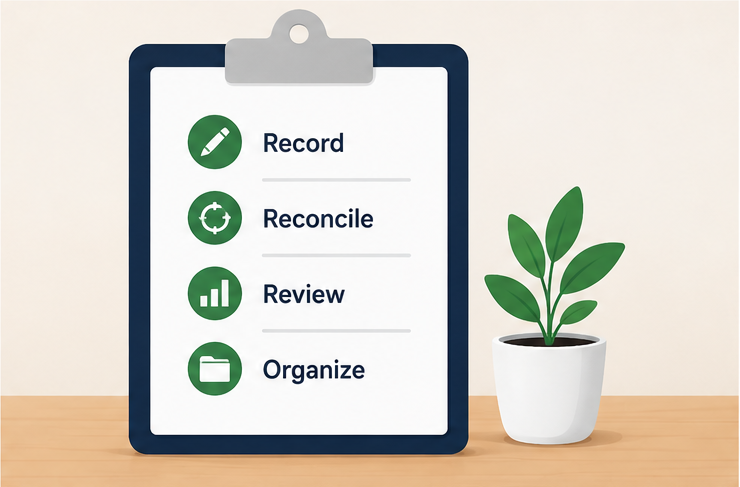
Regular reconciliation and review can help identify discrepancies while transactions are still relatively fresh.
Consider establishing a monthly close process that includes:
- Reviewing uncategorized transactions
- Reconciling bank and credit-card accounts
- Checking outstanding customer invoices
- Reviewing unpaid bills
- Examining your profit and loss statement
- Reviewing your balance sheet
- Investigating unusual balances or transactions
- Organizing supporting documents
A little maintenance throughout the year can be much easier than a major cleanup later.

What Good Bookkeeping Actually Looks Like
Once you strip away the myths, effective bookkeeping comes down to a few fundamental habits.
Record transactions consistently.
Keep business and personal finances separate.
Maintain appropriate supporting documentation.
Reconcile your accounts.
Review your financial reports instead of simply generating them.
Use automation carefully.
And seek professional help when your situation becomes too complicated or time-consuming to manage confidently.
You don’t necessarily need the most expensive accounting software or a complicated financial department.
You need records you can rely on.
When Should You Consider Professional Bookkeeping Help?
DIY bookkeeping can work well for some businesses, especially when transaction volume and complexity are low.
But professional help may become worthwhile when:
- You’re consistently behind on bookkeeping
- Reconciliations don’t balance
- You don’t understand your financial reports
- Your transaction volume has increased significantly
- You’ve added payroll
- You’re managing inventory or multiple sales channels
- You’re preparing for financing
- Your business structure or tax situation has become more complicated
Getting assistance doesn’t mean giving up control of your finances.
The right bookkeeping relationship should give you more visibility into your business—not less.
Stop Guessing. Start Knowing Your Numbers.
Good bookkeeping isn’t about making your business more complicated.
It’s about making your finances easier to understand.
Accurate, organized records help you see what’s working, catch problems early, prepare for tax obligations, and make decisions based on actual financial information rather than assumptions.
And that’s one bookkeeping fact worth remembering.
Ready for Cleaner, More Organized Books?
IntegriBooks helps small businesses simplify bookkeeping and gain greater clarity over their financial records.
Spend less time sorting through transactions and more time focusing on your business.
Explore IntegriBooks and discover how better bookkeeping can help you make more confident business decisions.
Disclaimer: This article is for general informational purposes only and does not constitute accounting, tax, or legal advice. Requirements vary by business and circumstances. Consult an appropriate qualified professional for advice specific to your situation.