


Knowing how long to keep financial records can save you from both extremes: throwing away documents you may still need or keeping every receipt and statement forever.
For U.S. taxpayers and small businesses, there isn’t one universal “seven-year rule.” The correct retention period depends on what the document supports, the applicable IRS period of limitations, and whether another legal, insurance, employment, or business requirement applies.
Here’s a practical guide for 2026.
Affiliate Disclosure: This article contains affiliate links. If you join Wealthy Affiliate through one of my links, I may earn a commission at no additional cost to you. I recommend only products and services I have personally used or genuinely believe will add value for my readers. All opinions expressed in this review are my own.
Why Keeping Financial Records Matters
Good records help individuals and businesses:
- Prepare accurate tax returns
- Support income, deductions, and credits
- Respond to an IRS notice or examination
- Track business income and expenses
- Establish the cost basis of property and investments
- Prepare financial statements
- Document transactions for lenders, insurers, or other legitimate purposes
Businesses may need invoices, receipts, account statements, payroll records, canceled checks, and other supporting documents to substantiate information reported on a tax return.
How Long Should You Keep Tax Records?
The IRS generally says you should keep records supporting income, deductions, and credits until the applicable period of limitations expires.
Here is the basic federal income-tax framework:
| Situation | General IRS Retention Period |
|---|---|
| Most tax records | 3 years |
| Claim for credit/refund after filing | Later of 3 years after filing or 2 years after tax was paid |
| Income omitted exceeding 25% of gross income shown on return | 6 years |
| Worthless securities or bad-debt deduction claim | 7 years |
| No return filed | Indefinitely |
| Fraudulent return | Indefinitely |
| Employment tax records | At least 4 years |
These periods aren’t a reason to automatically destroy a document on its third anniversary. You may still need the record for property basis, insurance, creditors, employment requirements, state taxes, contracts, or another purpose.
Keeping copies of filed tax returns can also be useful when preparing future or amended returns.
How Long Should Businesses Keep Financial Records?
No single IRS rule requires every business document to be retained for six or seven years.
Instead, businesses should retain documents long enough to support the income, deductions, credits, assets, payroll, or other tax items associated with them.
Examples include:
Receipts and invoices: Keep them for the applicable limitations period when they substantiate something reported on a tax return.
Bank and credit card records: Retain statements and related documentation for as long as they’re needed to substantiate relevant transactions.
Employment tax records: Keep them for at least four years after the tax becomes due or is paid, whichever is later.
Business assets: Keep purchase records, improvement costs, depreciation information, and other basis documentation for as long as needed to establish the asset’s basis, and then through the applicable limitations period after disposition.
Business type can also affect retention requirements, so businesses subject to industry-specific rules should establish a formal record-retention policy.
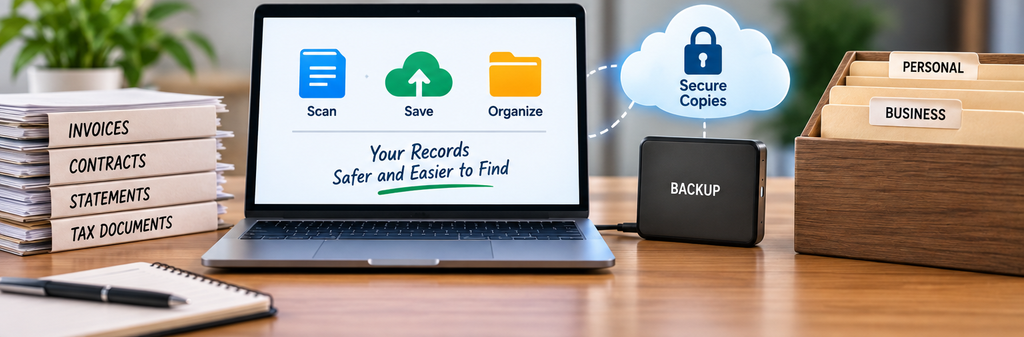
CTA: Keep Your Business Records Organized
Knowing how long to retain records is easier when your bookkeeping system keeps financial information organized from the beginning.
See how IntegriBooks can help you maintain cleaner, more organized financial records for your business.
What About Property and Investment Records?
Property records frequently need to be kept much longer than three years.
The IRS generally recommends keeping records related to property until the period of limitations expires for the tax year in which you dispose of it.
These records can establish:
- Purchase price
- Acquisition date
- Improvements
- Depreciation
- Certain deductions or losses
- Selling price
- Selling expenses
- Adjusted tax basis
For investments, retain records necessary to establish your cost basis and holding period. That can include purchase confirmations, reinvested distributions, corporate action information, and other basis adjustments.
Don’t automatically discard purchase records merely because several years have passed if you still own the asset.
Should You Keep Bank Statements for Seven Years?
Not necessarily.
No blanket IRS rule requires every bank or credit card statement to be kept for seven years.
Instead, ask what the statement proves.
If it supports business income, a deductible expense, tax basis, or another tax-return item, retain it for as long as that information needs to be substantiated.
A statement connected to a long-held asset may therefore need to be retained much longer than an ordinary monthly statement with no continuing tax or legal significance.
Which Records Should You Keep Permanently?
Some important documents deserve long-term or permanent storage even when they aren’t subject to an IRS “forever” rule.
Examples may include:
- Birth and death certificates
- Marriage certificates
- Social Security cards
- Wills and estate documents
- Property deeds
- Certain closing documents
- Business formation documents
- Important legal agreements
These documents often serve legal, ownership, identity, or estate purposes rather than simply supporting a tax return.
Are Digital Financial Records Acceptable?
Businesses don’t necessarily need rooms filled with paper files.
IRS guidance permits electronic recordkeeping systems when applicable requirements are satisfied. Electronic records should remain accurate, complete, accessible, retrievable, and legible, with appropriate controls to protect them from unauthorized creation, alteration, or deletion.
A good digital filing structure might look like:
2026 → Taxes → Income → Expenses → Payroll → Assets → Bank Statements
Use consistent filenames such as:
2026-04-15_VendorName_Equipment_1250.pdf
This makes records much easier to locate than folders filled with files named Scan001.pdf.
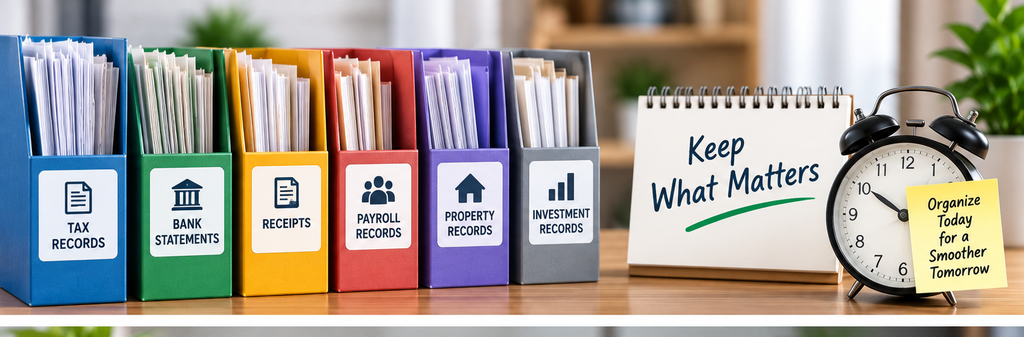
Don’t Confuse Cloud Sync With Backup
Uploading documents to cloud storage can improve accessibility, but don’t assume that having a cloud folder automatically provides all the backup protection your business needs.
For important financial records:
- Maintain appropriate backups
- Restrict access to authorized users
- Enable multifactor authentication
- Protect sensitive information appropriately
- Keep devices and software updated
- Test whether important backups can actually be restored
Your goal isn’t simply to have another copy. It’s to have a recoverable copy if the primary records are lost, corrupted, deleted, or compromised.
How to Organize Financial Records in 2026
A simple system is usually easier to maintain than a complicated one.
1. Separate Personal and Business Records
Use separate bank accounts, folders, and bookkeeping processes where appropriate. This makes transactions easier to identify and substantiate.
2. Organize by Year and Category
Create consistent folders for taxes, payroll, receipts, invoices, assets, banking, insurance, and other major categories.
3. Capture Supporting Documents Promptly
Don’t wait until tax season to hunt for receipts. Save supporting documentation while transactions are still easy to identify.
4. Control Access
Employees should have access only to the financial records required for their responsibilities.
5. Review Records Annually
Once a year, identify documents that have reached the end of their retention period—but check for other requirements before destroying them.
6. Dispose of Records Securely
Shred sensitive paper documents and use appropriate methods for securely disposing of electronic records and storage devices.
Common Record-Retention Mistakes
Keeping everything for seven years.
The IRS does not impose a universal seven-year rule.
Deleting asset records after three years.
Basis records may be needed for as long as you own the property and beyond its eventual disposition.
Keeping only bookkeeping totals.
Accounting software entries don’t necessarily replace invoices, receipts, statements, and other documents needed to substantiate transactions.
Assuming your bank will always have old statements.
Your record-retention strategy shouldn’t depend entirely on another organization’s future availability.
Destroying records based only on federal tax rules.
State laws, employment requirements, insurers, lenders, contracts, or industry regulations may require longer retention.
Frequently Asked Questions
Should I keep tax records for three or seven years?
For many federal income-tax situations, the general period is three years, not seven. However, specific circumstances can require six years, seven years, or indefinite retention.
How long should I keep payroll records?
For federal employment tax purposes, the IRS generally requires employers to keep employment tax records for at least four years after the tax becomes due or is paid, whichever is later.
How long should I keep receipts?
Keep receipts as long as needed to substantiate relevant tax-return items or meet another applicable requirement. Receipts establishing the basis of a long-term asset may need to be retained much longer than ordinary expense receipts.
Can I scan financial documents and destroy the originals?
Electronic records can satisfy IRS recordkeeping requirements when they meet the applicable electronic-storage standards, but they don’t automatically eliminate the need for every original. A document may be subject to other legal, contractual, insurance, or regulatory requirements.
Create a Record-Retention System You Can Actually Follow
The best answer to “How long should you keep financial records?” isn’t simply “seven years.”
Instead, determine what the document proves, which retention requirement applies, and whether you’ll need it for another purpose.
For many tax records, three years is the starting point. Other circumstances require four, six, seven, or more years—and property records can follow an asset throughout the time you own it.
A consistent bookkeeping and document-management system makes those decisions much easier.
CTA: Build Better Financial Records With IntegriBooks
Organized records make bookkeeping, tax preparation, financial reporting, and everyday business decisions easier.
Connect with IntegriBooks to build a cleaner, more organized bookkeeping process for your business.